Ideas
By Stephen Mwangangi Munyoki
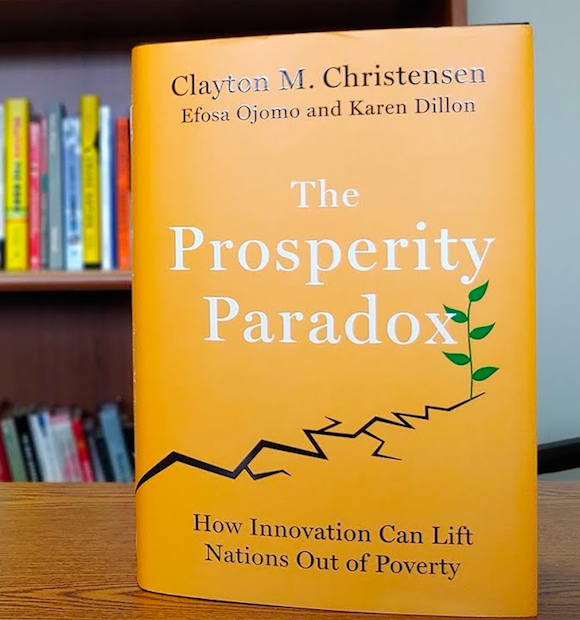
On my first day at Future Africa (my former employer), I received a 368-page book called “The Prosperity Paradox” signed by Efosa Ojomo himself. Fresh from university with a law school-fried brain, I almost set it aside. Thank God I didn’t.
What I discovered wasn’t just another development theory; it was a complete reimagining of how emerging economies actually grow. And now, as an early-stage investor, I see its principles playing out in real-time with the birth of every new African unicorn. (African unicorns are startups with a valuation of at least $1 billion. This term was coined in 2013 to describe the rarity of such companies.
The Prosperity Puzzle No One Could Solve
For decades, development efforts have focused on what’s missing: building wells, constructing schools, and establishing governance systems. Yet Ojomo discovered a fundamental flaw in this approach when his own non-profit’s wells in Nigeria broke within nine months. His book highlights a critical paradox: despite the immense sums of money and well-intentioned efforts poured into development aid, many emerging economies have not experienced sustainable prosperity. In fact, research indicates that at least twenty countries that have received billions of dollars in aid are now economically worse off.
The missing piece? Market-creating innovations.
The Alchemy of Market Creation
“The Prosperity Paradox” posits that the missing piece in the economic development puzzle is “market-creating innovation.” This type of innovation operates as a “pull” mechanism, in stark contrast to traditional aid’s “push” approach. Instead of focusing on fixing existing problems by supplying resources, market-creating innovation identifies areas of “non-consumption” where people have a need but lack access to an affordable and accessible solution and then develops products and services to meet those needs.
This innovation creates demand, which in turn “pulls” in the necessary resources, infrastructure, and even the development of institutions required for sustained growth.
At its core, market-creating innovation transforms complicated, expensive products into simple, affordable ones that unlock entirely new customer segments. When this happens, three powerful forces emerge:
- Jobs multiply – Not charity-dependent positions, but sustainable employment that builds real economic foundations
- Tax revenues grow – Giving governments resources to invest in their own development
- Culture transforms – Creating a self-reinforcing ecosystem that values entrepreneurship and innovation
The story of Celtel, founded by Mo Ibrahim in 1998 (initially as MSI Cellular Investments), stands as a powerful illustration of market-creating innovation in Africa. Ibrahim’s vision was to connect the African continent through mobile telecommunications at a time when landline infrastructure was severely lacking and mobile phones were considered a luxury. He would reach out to the world’s biggest telecoms and ask them:
His idea was met with considerable skepticism. “You want to give cell phones to the average African? There’s poverty, corruption, no infrastructure!“
But Ibrahim knew the opportunity was too big to ignore. By the start of the 21st century, Celtel had expanded quickly enough to become one of the largest companies providing mobile communications services in Africa, offering coverage to more than a dozen countries and hundreds of millions of people. The demand across the content had grown so high that when they set up operations in Gabon, for example, customers actually knocked down the door of one of their offices trying to get in. That’s how badly people wanted to make phone calls.
That “crazy” idea allowed Ibrahim to sell Celtel to MTC Kuwait for $3.4 billion and has spawned over a hundred mobile companies across Africa, providing millions of jobs and generating hundreds of billions in economic value.
The Early-Stage Investor’s Hidden Superpower
As early-stage investors in emerging markets, we’re not just funding businesses but catalyzing entirely new markets. This became clearer to me with every investment memo I drafted since I viewed this as an opportunity to give a founder the chance to change the world, with their unique solution to a problem that’s been deemed “too hard to solve.
But to do this, an investor would have to adopt a different evaluation lens:
- Seek non-consumption opportunities. The biggest opportunities aren’t in serving existing customers better; they’re in making non-consumers into customers by making products affordable and accessible. In the early 2000s, many African consumers couldn’t afford monthly subscriptions, so Celtel created prepaid cards that offered cellular service for just a few dollars. Similarly, Safaricom’s M-Pesa addressed a massive gap in financial services. Prior to mobile money, a considerable segment of the population was left out of the formal banking system. By enabling financial transactions via mobile phones, M-Pesa created a new customer base from non-consumers of traditional banking services. This innovation redefined financial accessibility and offered a sustainable model tailored to the local economic ecosystem.
- Value infrastructure creativity. The founders who create their own infrastructure solutions rather than waiting for them are often the true market creators. Paystack is a Nigerian digital payments company that built the critical infrastructure enabling businesses in Africa to process online payments seamlessly. Before its emergence, many African businesses struggled with outdated, unreliable methods for receiving payments, which often limited growth and excluded them from the digital economy. With strong backing from local investors and ecosystem partners, Paystack developed secure and efficient payment systems that integrated easily with local and international platforms. This transformation of payment infrastructure not only boosted trust and efficiency in electronic transactions but also opened the door for a vibrant, modern e-commerce ecosystem across the continent following Stripe’s $200 million acquisition of Paystack in 2020.
- Look for pattern-breaking business models. Not just incremental improvements, but fundamental rethinks of value creation and delivery. Andela, founded in 2014, is a company that trains tech talent and connects them with global companies. At a time when platforms like LinkedIn only served to connect companies with existing talent, Andela broke the mold by purposefully training emerging tech professionals, especially from Africa, transforming raw potential into globally competitive expertise. This pattern-breaking approach created an entirely new market by addressing the tech skills gap head-on, cultivating talent where it was scarce and enabling companies to tap into a previously overlooked reservoir of innovation and capability.
Beyond the Obvious: Real Examples Transforming Africa
M-KOPA, Moove, and Ilara Health perfectly demonstrate market-creating innovation in action.
M-KOPA is a Kenyan financing startup that offers pay-as-you-go solar systems to households without reliable or affordable energy access. Instead of requiring a hefty upfront payment for solar panels, M-KOPA lets customers pay in small, daily installments. This simple model transforms energy poverty into a sustainable asset, enabling families to eventually own not only solar systems but also build credit for other important items like smartphones and appliances, all while reducing reliance on costly and unreliable traditional power sources.
This approach has connected over 3 million homes in East Africa to clean energy, replacing costly and hazardous kerosene lamps.
Moove, a Nigerian startup, addresses the challenge of vehicle ownership among ride-hailing drivers by offering revenue-based financing. Drivers can acquire vehicles by committing a portion of their weekly earnings, eliminating the need for traditional credit checks. This isn’t just about getting a car; it’s about enabling thousands of drivers to start or expand their ride-sharing businesses, generate a steady income, and even build a credit history.
Since its inception in 2020, Moove has financed over 20,000 vehicles across Africa, the Middle East, and Europe. This model not only provides drivers with the means to earn a sustainable income but also helps them build credit histories and access additional financial services.
Meanwhile, Ilara Health is a Kenyan healthcare startup addressing a major challenge in rural Africa: millions of people don’t have easy or affordable access to basic medical tests. In many rural areas, clinics lack diagnostic tools, so doctors have to send patients to distant labs, a process that many patients simply can’t afford or manage.
Ilara Health partners with advanced technology companies using robotics and artificial intelligence to develop lower-cost diagnostic devices. They bundle these devices into a smart, easy-to-use platform and offer them to local doctors through financing options. This way, doctors can perform essential tests right in their clinics, leading to quicker diagnoses, better care, and increased clinic revenue. Over time, the data collected from these tests will help with broader community disease detection and prevention efforts.
Each company isn’t just selling products, they’re creating entirely new markets by making previously inaccessible services affordable to millions of Africans who were completely excluded before.
Our Mission as Early-Stage Investors
Ojomo puts it plainly: “The investors who steward capital are the most important piece of this puzzle. The role you play in not just returning capital to providers, but in building a country and a continent, is crucial.”
The evidence supports this view. According to Partech’s 2024 Africa Tech Venture Capital Report, despite global economic headwinds, African tech startups raised $3.2 billion across 534 deals in 2024, with fintech, climate tech, and logistics (sectors ripe for market-creating innovations) capturing the largest share of funding. Even more telling, seed-stage companies accounted for 69% of all deals, showing that investors continue to recognize the transformative potential of these young companies.
Clearly, this paradigm shift from “building wells to enabling entrepreneurs” is already showing results. Ten years ago, Africa had zero unicorns, and the total startup venture funding was $400 million for the entire continent. Today, that number has more than tripled, with many more on the horizon.
As early-stage investors, we have the privilege of fueling this transformation. We shouldn’t just seek financial returns; we need to back entrepreneurs who create entirely new markets that pull societies toward prosperity. These founders don’t just build businesses; they build economic ecosystems that create jobs, generate tax revenue, and inspire new generations of innovators.
In summary, the next market-creating innovation is being built right now by a founder who sees opportunity where others see only obstacles. Finding them isn’t just good investing, it’s the key to unlocking sustainable prosperity across our continent and other emerging markets.
That’s the true power of market-creating innovations. And that’s why I can’t put Ojomo’s book down, while you need to pick it up.
The views expressed in this article are my own and not of any organization/fund I am affiliated with.
0 Comments